Supporting Mental Health through the Workforce System
Mental Health and the Workforce System
Mental health matters at every stage of a person’s professional life, whether they are searching for a job, maintaining a job, or advancing in their career. Discover how workforce professionals can make a difference.
ON TOPIC
Mental health conditions are common
Common mental health conditions include anxiety, depression, bipolar disorder, and post-traumatic stress disorder or PTSD. Such conditions affect people’s thoughts, emotions, and behaviors. In turn, factors like life experiences, stress, trauma, stigma, misconceptions about the ability of a person with a mental health condition to work or about the cost of reasonable accommodations can affect a person’s mental health condition.
Visible or not, mental health conditions wield significant influence over people’s ability to navigate daily life—including engaging in employment and achieving professional goals. Employment is not only a mental health outcome but also a determinant: Successful employment helps support people with mental health conditions by providing structure, financial independence, and a pathway to long-term stability.
The gap between the known prevalence of mental health conditions and reported disabilities in the workplace suggests that many individuals are not disclosing these conditions. Some people may not have a formal diagnosis or may not recognize their experiences as related to mental health. Others may choose not to disclose due to concerns about stigma or misunderstandings. Many individuals are unaware that they may qualify for benefits under the Americans with Disabilities Act because of their condition, so they don’t seek accommodations.
Workforce professionals play an instrumental role not only in supporting individuals in achieving employment goals but also, in fostering an environment in which mental health needs can be addressed as essential to successful workforce participation.
Mental health conditions affect all communities
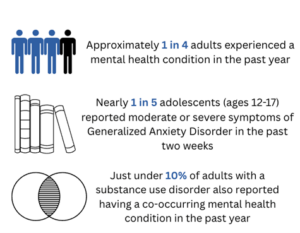
Source for infographic: SAMHSA (2024)
Keep reading for resources and strategies to help you build mental health-friendly environments for American job seekers, including:
• A framework for recognizing, responding, and supporting job seekers who may have mental health conditions.
• The successful work of disability resource coordinators in American Job Centers across New York State.
• Webinars and other resources focused on mental health in the workforce system.
Recognize, respond, and support
Workforce professionals can use the “recognize, respond, and support” method to help individuals with mental health conditions. This means recognizing signs of a mental health need, responding respectfully with empathy, and supporting people, including by connecting them to the appropriate resources. “Recognize, respond, and support” means making sure the workforce supports workers with mental health conditions—and helps job seekers move forward, not just in employment but also, in life.
Below are a few tips and reminders for workforce professionals to practice recognizing, responding, and supporting.
Recognize:
- Mental health conditions are common and can affect people’s ability to search for and keep jobs.
- Some disabilities are visible; many others, like anxiety and PTSD, are not.
- People with the same mental health condition may have different mental health needs.
- Recognizing the signs of mental health conditions improves awareness and encourages workforce professionals to respond effectively.
Respond:
- Workforce professionals are often the first point of contact for individuals seeking employment.
- Responding with empathy and compassion and using nonjudgmental language can make a big impact with job seekers, increasing effectiveness and success.
- Workforce professionals can support job seekers’ long-term well-being through simple actions that focus on each job seeker’s unique skills and needs.
Support:
- Listen actively and without judgment.
- Use respectful language.
- Acknowledge distress.
- Foster safe, stigma-free spaces.
- Identify available resources and provide appropriate referrals.
- Normalize asking for support and using services.
The chart below highlights the ways mental health conditions may manifest in people’s behavior and how small adjustments in a workforce professional’s response can create meaningful impact. When supported by workforce professionals, job seekers can remain fully engaged in pursuing their employment goals. And when the workforce system as a whole responds with support, outcomes improve—for job seekers, staff, employers, and communities.
Signs of Possible Mental Health Needs and Supportive Workforce Responses
| Signs of Possible Mental Health Needs | Possible Expressions/Behaviors | How Workforce Professionals Can Support |
|---|---|---|
| Changes in mood, energy, or focus | Trouble concentrating, low energy, seeming withdrawn, frustrating easily | Use nonjudgemental language to express understanding and support; adjust expectations; encourage small, manageable steps |
| Difficulty communicating or engaging | Quiet, avoids eye contact, seems distracted or overwhelmed | Use clear, simple language; offer breaks; allow time to process; confirm communication-related accommodations needs |
| Visible distress or signs of anxiety | Fidgeting, appearing nervous, avoiding conversations, excessively worrying about small tasks | Stay calm and reassure them; provide resources or referrals |
| Missed appointments or lack of follow-through | No-shows, late arrivals, incomplete tasks, difficulty staying organized | Normalize setbacks; brainstorm solutions together; check for underlying needs |
| Expressions of hopelessness or feeling overwhelmed | Making statements like “I can’t do this” or “It’s too much” or appearing tearful | Validate feelings; remind them of strengths; connect to appropriate supports |
Please note that the “recognize, respond, and support” method is intended to help workforce professionals recognize signs of potential mental health needs. It is not a framework for engaging with individuals with formally diagnosed conditions. However, if a job seeker requests help in getting a formal diagnosis or more tailored support around his or her mental health condition, it is helpful for a workforce professional to have appropriate referral organizations in mind.
ON THE GROUND
Promising practices from New York State
New York State supports individuals with mental health conditions by employing disability resource coordinators (DRCs) through NY SCION.
DRCs are important resources and collaborators for staff at American Job Centers (AJCs) who work with job seekers with disabilities. DRCs promote the employment of job seekers with disabilities by strengthening relationships with local businesses and supporting the implementation of workplace accommodations. DRCs also coordinate integrated resource teams and provide guidance around the Ticket to Work program, benefits, and disability-specific workshops.
Building on the work of four rounds of federal Disability Employment Initiative pilot funding and the Disability Program Navigator initiative, NY SCION aims to “expand the already successful network of disability resource coordinators (DRCs) to all 33 local workforce development areas to increase the capacity of their service delivery and better serve individuals with disabilities” (NY SCION).
Through NY SCION, DRCs provide AJC staff and local employers with training on mental health (including accommodation request forms), job seeker workshops, and benefits advising. DRCs in Monroe County also provide enhanced recovery services. DRCs apply these strategies on the ground and work across workforce development programs and with community partners to help individuals with mental health conditions stay engaged in employment and recovery.
For example, at RochesterWorks, an AJC in upstate New York, DRCs held training sessions for staff on topics such as mental health, autism, Tourette syndrome, and others. The sessions featured guest speakers, including representatives from agencies that support people with these conditions, who offered advice on connecting customers to their services and completing cross-referrals. As of June 2025, RochesterWorks was also developing a protocol for workforce staff to engage with customers who may be experiencing a mental health crisis.
These are just a few examples of how NY SCION is striving to improve employment outcomes for all job seekers, including those with mental health conditions.
ON CUE
Resource:
This webpage from the Office of Disability Employment Policy (ODEP) supports a mental health-friendly work culture built by employers, individuals with disabilities, service providers, policymakers, and youths/young adults.
Resource:
The “Mental Health at Work: What Can I Do?” public service announcement promotes ways to build workplace well-being by setting the tone for a supportive workplace, providing or requesting accommodations, and being a source of support to peers and colleagues.
Resource:
Workplace Mental Health Toolkit
This toolkit from the Employer Assistance and Resource Network on Disability (EARN) teaches organizations how to create a mental health-friendly workplace and help their employees access resources to improve well-being.
Resource:
This webpage from the Job Accommodation Network (JAN) offers practical guidance on workplace accommodations and ways to foster supportive workplaces and provides resources for individuals with mental health conditions.
Resource:
New York’s Your Dream, Your Team Toolkit
Developed during New York’s Disability Employment Initiative, this toolkit provides helpful resources and clear guidance on forming and maintaining integrated resource teams.
Webinars
(June 2025)
This webinar highlights practical approaches to increasing mental health awareness within workforce programs. Speakers from the National Center on Leadership for the Employment and Economic Advancement of People with Disabilities (LEAD Center) and practitioners from the Finger Lakes Workforce Investment Board and RochesterWorks in upstate New York share real-world examples of how AJCs and workforce systems are implementing effective strategies to address mental health. Attendees gain tools they can apply immediately to better serve job seekers and support their own teams.
LEAD CENTER RECENT AND UPCOMING EVENTS
Stay informed about upcoming webinars and events by visiting the LEAD Center’s events webpage.